
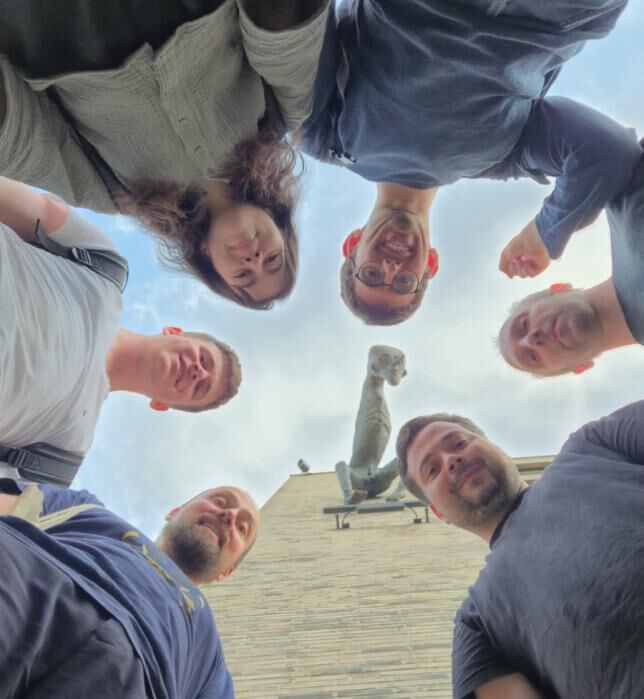
The 3rd Biomolecular Modelling Workshop (BMMW2025), held on 1-3 September 2025 at NTNU in Trondheim, successfully strengthened the collaboration between the groups of Markus Miettinen (UiB) and Gaston Courtade (NTNU) and advanced the integration of computational molecular dynamics (MD) and experimental nuclear magnetic resonance (NMR) approaches within the NMRlipids DLN project. The workshop fostered cross-disciplinary exchange, enabled participants to gain a deeper understanding of complementary research methods, and facilitated collaborative discussion of emerging scientific questions.
Organized and led by PhD students, the workshop provided early-career researchers with valuable experience in leadership, session management, and scientific dialogue. Each of the seven participants delivered a 20-minute presentation followed by 35–40 minutes of in-depth discussion, ensuring interactive engagement and critical analysis of the presented work. A practical exercise combining AI and MD simulations offered hands-on training, while team-building activities further strengthened collaboration within and across groups.
Day 1 featured presentations on high-fidelity MD, molecular dynamics of intrinsically disordered proteins, and structural analysis of polysaccharide variants. Day 2 included sessions on surfactant monolayers, ligand binding studies, and enhanced sampling techniques in MD, alongside the practical workshop and a team-building activity (bowling). The event concluded with an evaluation session and discussion of future directions.
 Participant feedback emphasized the value of the one-hour presentation format, highlighting the depth of scientific discussions and the effectiveness of practical exercises. Suggestions for future workshops included: involving Master’s students with shorter talks, extending practical exercises to NMR-related topics, inviting external guest groups, but keeping the 10–12 participants limit to maintain interactivity. Future meetings should be hosted off-campus to reduce scheduling conflicts; summer 2026 was proposed for the next workshop.
BMMW2025 fully achieved its objectives by promoting high-quality scientific exchange, providing leadership opportunities for early-career researchers, and strengthening the understanding of computational and experimental methodologies. The outcomes will directly benefit the NMRlipids project through improved integration of experimental and computational data within the NMRlipids databank, a more cohesive NMRlipids and DLN research community, and long-term cross-disciplinary collaboration.
We sincerely thank DLN for their financial support, which significantly contributed to the workshop’s success.