
Program
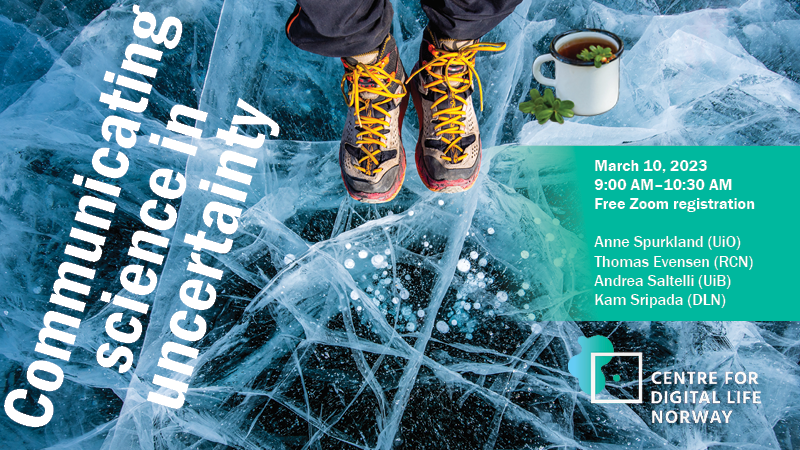
09.00-09.05: Welcome – Christoffer Hals, Communication advisor, Centre for Digital Life Norway
09.05-09.20: Reformation in the Church of Science (Andrea Saltelli, visiting researcher at the Centre for the Study of the Sciences and the Humanities at the University of Bergen, Norway)
09.20-09.35: “Communicating science in times of uncertainty - with examples from the Covid pandemic (Anne Spurkland, immunologist and professor at the University of Oslo – winner of several science communication awards)
09.35-09.50 To maintain society's trust in research, communication must improve (Thomas Evensen, Special Advisor at the Research Council of Norway)
09.50-10.00: Communicating science in uncertainty (Kam Sripada is Centre Manager for Centre for Digital Life)
10:00 – 10:25 Panel discussion
About the speakers
Andrea Saltelli is an Italian statistician and visiting researcher at the Centre for the Study of the Sciences and the Humanities at the University of Bergen, Norway. His research focuses on sensitivity analysis, uncertainty and model validation, and the philosophy of models, and he has published numerous papers and books on these topics. He is also known for his contributions to the development of global sensitivity analysis, a method for studying the behavior of complex models. Saltelli has held various academic positions in Europe, including at the European Commission's Joint Research Centre. He is currently academic counselor at the University Pompeo Fabra - Barcelona School of Management (UPF-BSM) and a visiting scientist at the Italian National Research Council (CNR).
- Suggested reading: Andrea Saltelli and Daniel Sarewitz, 2022, Reformation in the Church of Science. How the truth monopoly was broken up. The New Atlantis, issue Spring 2022.
Anne Spurkland is a Norwegian immunologist and professor at the University of Oslo. Her research focuses on immunological diseases, particularly the genetic and immunological factors involved in autoimmune diseases such as type 1 diabetes, multiple sclerosis, and rheumatoid arthritis. She has also been active in promoting science communication and outreach, and has served as the President of the Norwegian Association of Immunologists. In addition, Spurkland has been a member of several national and international committees and councils related to science and education.
- Spurkland recently held the 200 minute Aarebrot Lecture explaining the human immune system.
Thomas Evensen is a former Executive Director of Communications at the Research Council of Norway. He served in this position from 2011 to 2018 and was responsible for developing and implementing communication strategies to promote the council's activities and achievements. Evensen has also held various other communication and public relations positions in Norway, including at the Ministry of Education and Research and the Norwegian Broadcasting Corporation (NRK). In addition, he has been involved in international media and communication projects and has served on the board of the European Science Communication Network.
- Suggested reading: For at samfunnet fortsatt skal ha tillit til forskning, må formidlingen bli bedre
Kam Sripada is a neuroscientist at the Norwegian University of Science and Technology (NTNU) and Centre Manager at the Centre for Digital Life Norway. In this role, she coordinates the centre’s operations to support and collaborate with over 40 digital biotechnology projects and national and international partners. Kam has studied how social and environmental factors influence child brain development and contribute to global health inequalities. She has collaborated closely with UNICEF, including co-leading the creation of the evidence-based UNICEF program Healthy Environments for Healthy Children launched in 2021.
-
Suggested reading: Sripada et al., (2022) "A Children’s Health Perspective on Nano- and Microplastics," Environmental Health Perspectives
About the seminars
"Digital Frukost" is an open breakfast seminar series focusing on research activities at the interface between the biological sciences and that of mathematics, computer science, physics or engineering. Examples of such research activities could be mathematical or computational modeling of biological systems, application of engineering/control systems theory on biological systems or inspired by biological systems, application of mathematics/statistics/machine learning to analyze big data in health or marine sector; from sensor systems, imaging or omics technologies etc.
For questions, please reach out to:
 Marta Eide, marta.eide@uib.no
 Christoffer Hals, christoffer.hals@mn.uio.no