
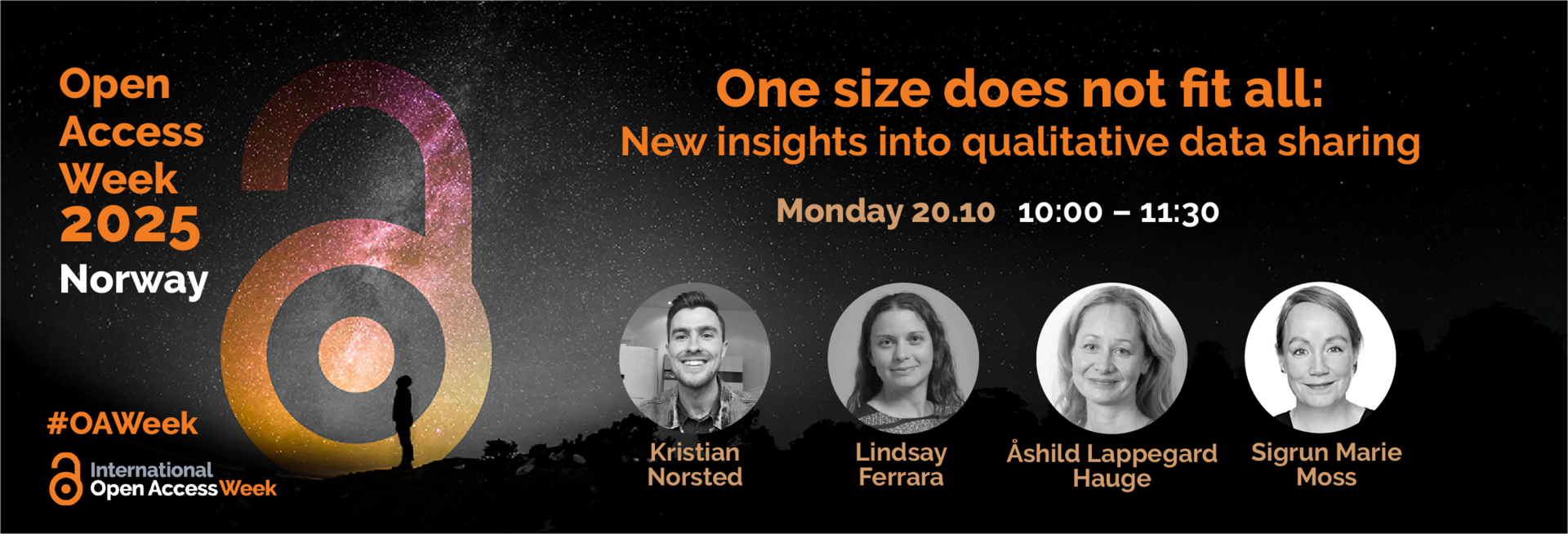
Program
1. Welcome and introduction to the webinar from the organizers
2. Invited talks
- Kristian Sandbekk Norsted: Qualitative Research, Data Sharing, and Ethical Engagement in the Age of Big Data
- Lindsay Ferrara: Creating an open-access, multimedia corpus for Norwegian Sign Language: A benefit to researchers and the deaf community
- Åshild Lappegard Hauge and Sigrun Marie Moss: How regulatory norms meet epistemological and ethical challenges in sharing qualitative interview data
3. Questions and discussion
4. Closing remarks
Speakers
Kristian Sandbekk Norsted: Qualitative Research, Data Sharing, and Ethical Engagement in the Age of Big Data
This talk examines some of the unique ethical and practical challenges associated with qualitative research data. As demands for openness and data sharing increase across the research landscape, it considers how researchers can address these expectations without compromising ethical integrity. The discussion is framed by current political-economic conditions—drawing on concepts such as surveillance capitalism and technofeudalism—as well as a Humboldtian understanding of scholarship as a public good. Within this context, openness is presented not as a threat, but as an important way to uphold ethical standards in research.
Kristian Sandbekk Norsted is a senior advisor at Østfold University College, where he leads the institution’s work on open science. He holds a PhD in cultural anthropology and works at the intersection of research policy, ethics, privacy, and open science.
Lindsay Ferrara: Creating an open access, multimedia corpus for Norwegian Sign Language: A benefit to researchers and the deaf community.
This talk will consider some of the issues and benefits of creating an open-access linguistic corpus of Norwegian Sign Language. Specifically, Prof. Ferrara will discuss how researchers can ethically collect and archive personal data, share it with academic and other stakeholders, while maintaining integrity and respect for language users.
Lindsay Ferrara is a theoretical and applied linguist working at NTNU. She has recently collected and published the first Corpus of Norwegian Sign Language, the language of the Norwegian deaf community, as a way to promote this minority language through documentation and description.
Åshild Lappegard Hauge and Sigrun Marie Moss: How regulatory norms meet epistemological and ethical challenges in sharing qualitative interview data
In this presentation, we will explain how the epistemological basis for sharing interview data differs in most qualitative approaches from that in quantitative methods. We will discuss different levels of sharing and provide examples of when interview data is too sensitive and context-dependent to share, and when it is historically valuable and necessary to share.
Åshild Lappegard Hauge is a professor at the Department of Psychology at the University of Oslo, where she teaches qualitative methods. She works mainly within the field of environmental psychology. She also conducts research on the unintended challenging consequences of Open Science on qualitative methods, in the research project ReDemOS.
Sigrun Marie Moss is a professor at the Department of Psychology at the University of Oslo, where she teaches cultural psychology and qualitative methods. She works mainly within the field of cultural and political psychology. She also conducts research on the unintended challenging consequences of Open Science on qualitative methods, in the research project ReDemOS.
Event organisers
University of Oslo ReDemOS project, Norwegian University of Science and Technology, Østfold University College
Host: Agata Bochynska
Co-host: Dag-Even Martinsen Torsøe