
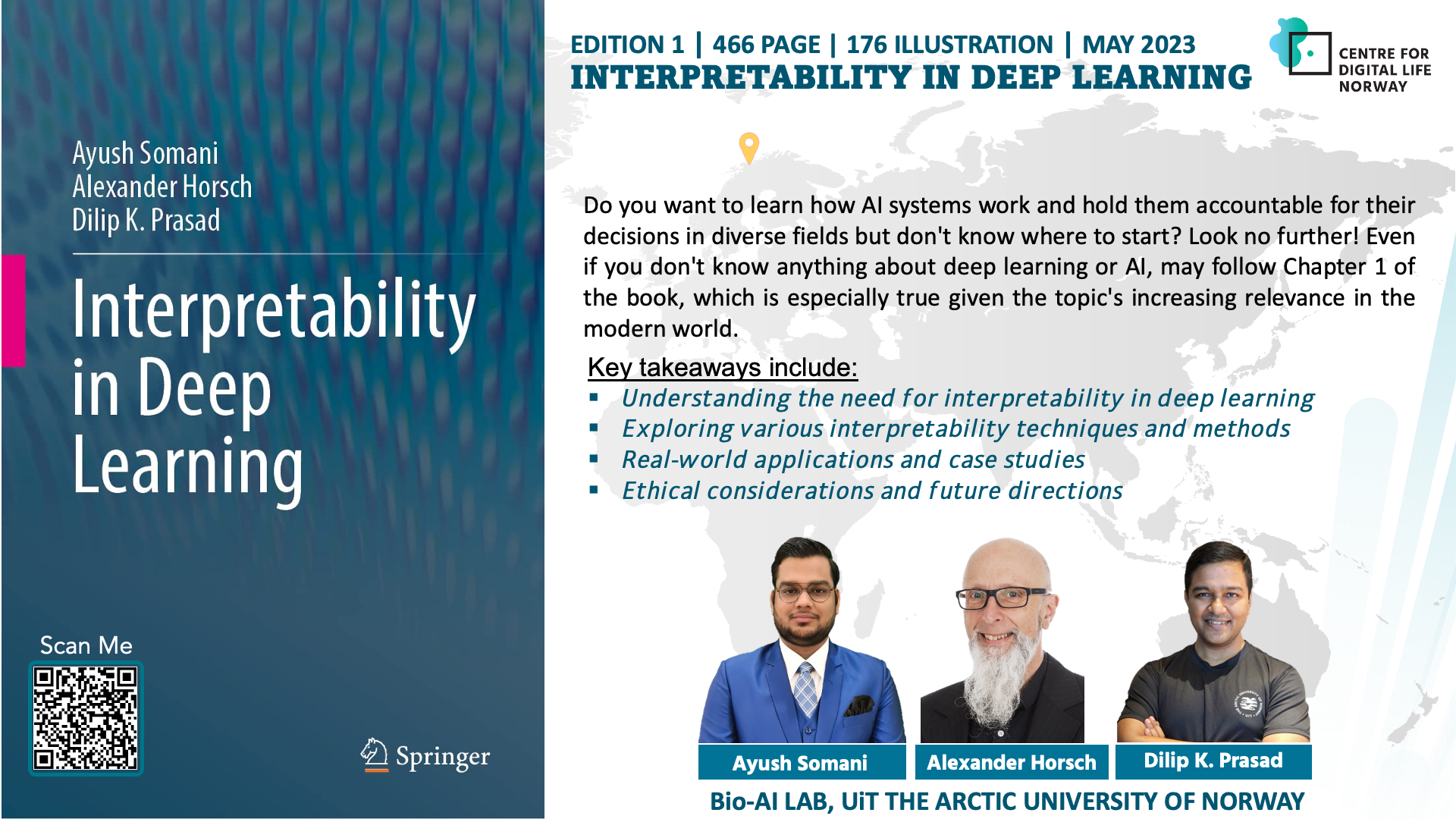
”The book will be an invaluable tool for researchers, educators, and other professionals who want to better understand how deep learning approaches can be made trustworthy. Its practical utility is further increased by the addition of supporting digital content, codes, and resources,” the authors say.
Bridging the interpretability gap in AI
The book is now accessible to a wide range of readers worldwide in both hardcopy and e-book formats. Published on May 1st, 2023, the book attempts to fill a crucial void in the existing literature, providing researchers and practitioners with a systematic approach to address the challenges of interpretability in the AI community. Although the previous emphasis in the community was on precision, interpretability has become an increasingly relevant topic as these models become more complex.
From master’s thesis to 500 page book
What began as Ayush Somani's master's thesis project in 2020, developed under the PhD supervision of Dr. Dilip K. Prasad and Dr. Alexander Horsch, into a nearly 500 page book that was submitted to Springer Nature in June 2022. The book's content spans a wide range of subjects.
Architectures, techniques, and perspectives in deep learning
The book starts by outlining the background, intended use, and timeline of deep learning while emphasizing the progression towards black-box models. Then it delves into various contemporary topics, such as neural network architectures, learning processes, and challenges. The trade-off between knowledge versus performance is covered, along with abstract knowledge encoding, visualization techniques, and knowledge propagation during optimization. The interpretability strategies for particular architectures, including convolutional neural networks, autoencoder networks, adversarial networks, graph learning strategies, and fuzzy deep learning, are also a major focus of the book. By discussing multiple deep learning architectures, it allows readers to develop a broader perspective on interpretability across different models.
Black Box of Deep Learning and Human interpretability
Overall, the book addresses the significant disconnect between the need for human interpretability of the knowledge models encoded and the black-box nature of deep learning architectures. With a focus on neural network architectures specifically, the book offers a thorough curation, exposition, and illustrative discussion of recent research tools and techniques for interpreting deep learning models. It covers fundamental concepts, state-of-the-art approaches, and emerging concepts, offering breadth and depth on real-world applications and case studies from numerous fields, including computer vision, optics, and natural language processing.
Bringing the book to life in DLN supported summer school
The authors say the subject of the book is highly relevant for the upcoming course in Tromsø in June which is supported by the Digital Life Norway Research School.
“We extend our gratitude to the DLN team for supporting a 5 ECTS Summer School proposed on this subject to be organized in Tromsø from June 12–16, 2023, bringing this dedicated book to life and possibly inspiring the development of specialized graduate courses.”
You can order and download the book here.