

Labels are useful tools that help identify things around us. Sometimes, labels are physical tags, and sometimes they are simply mental notes used to identify a place or an event. Labels can be short to denote what they are, or descriptions like what we think of them. Either way, labels are important for us to get a sense of reality and categorize the huge diversity of things and events around us in nice little boxes. Some people may like to label their wardrobe drawers or spice jars in their kitchen cabinets. While some may just keep their labels as ballpark mental notes.I for one like to label the music on my Spotify app playlist for different moods. Interestingly we even label our house plants and pets! We also use our labels to convey details to others who are not aware of it. For example, tell your friend who lives in Barcelona, how nice is the weather in north Norway. In short, it is hard to live in a world without labels. But ironically enough, labels can introduce confusion! But weren’t labels meant to reduce confusion? One may wonder. The answer is yes and no, the devil lies in the details!

Let’s see how labels work (with a quick exercise):
If I can use only one label to describe my neighbor's pet Fiji, I would say…
- Fiji is a chocolate-brown retriever. (Label 1)
With this, can you draw a mental picture of Fiji? Hold onto this picture.
Now let’s put a few more labels on Fiji.
- Fiji is a 6-month-old puppy. (Label 2)
- She is shy around new people. (Label 3)
- She is full of energy. (Label 4)
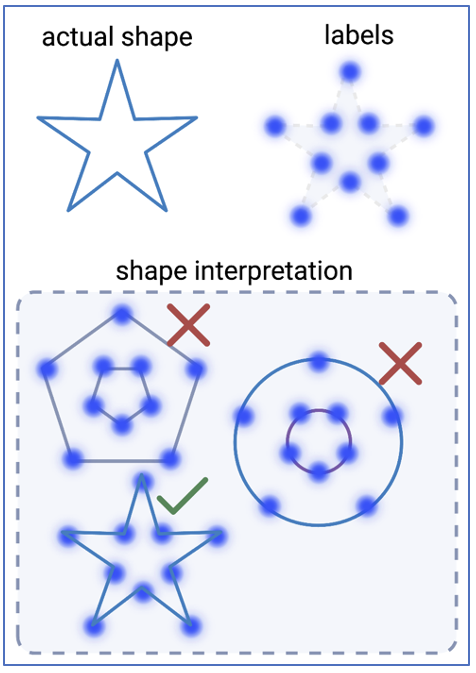 Now draw a picture of Fiji with the new labels and compare it with your initial picture. Aren’t they different?
Note how inadequate our first picture of Fiji was.
Labels convey incomplete information and sometimes give us a false sense of reality, referred to as confirmation bias in Psychology. Interestingly, you will note how much a few extra labels help us get a closer picture of Fiji-the puppy. When you meet Fiji in person, you may find the reality is even more different even though all the labels were accurate.
Importance and limitations of molecular labelling in life science research
In life science research, we label our samples to recall where it comes from and to whom it belongs. As things are often too small in our cells to see with the naked eye, to see what’s inside, we often label molecules with chemical tags and see these labels as a proxy of the molecules under a microscope. These labels then help us get an estimate of where the molecules exist to answer questions about how life functions. We can also see if something suspicious or interesting exists in those cells. Sometimes these labels are enough to arrive at the right conclusions. And sometimes they can be misleading just as it is shown in the figure above.
Advancements and challenges of label-free microscopy in life science research
Today our understanding of life has come a long way, and so has microscopy. Now we have microscopes that do not need biological samples to be labeled. No labels mean the ability to see the real thing and therefore an endeavor of bias-free data interpretation. No labels also mean no chemical toxicity and thus a chance to see the cells in action. These labelfree microscopes also come in different shapes and formats to provide physical, chemical, or architectural information about your samples while they are living and breathing. The future of labelfree microscopes is a promising one, especially due to the possibility to label without labeling. This is done by using the natural properties of the molecules themselves to label them. But when we see life without labels, one can easily lose sight of a needle in a haystack. Thus, a balance needs to exist between putting labels and not putting them.
So, are labels okay? There is no one correct answer to this question in life and life sciences alike. But perhaps the answer lies in the quest to decode the mystery that is life and use the labels or lack thereof as tools as we embark on this venture.
To know more about labelfree microscopes, please read our article in Nature here.
Involved projects: OrganVision project (EU H2020 FET Open RIA project id 964800) and Digital Life Norway project nanoRIP

Biswajoy Ghosh is a postdoctoral researcher in the Department of Physics and Technology at UiT- The Arctic University of Norway in Tromsø. His research interest lies in integrating life science with optical imaging. To do so, Biswajoy is looking into biological questions that can be uniquely answered by advanced labelfree microscopy methods. He has been working in the multidisciplinary junction of biology, imaging, and material science and working with 3D lab-made biological models.

Krishna Agarwal is a professor in the Department of Physics and Technology at UiT- The Arctic University of Norway in Tromsø. She works in the field of labelfree microscopy, computational imaging, and optical nanoscopy. Krishna's research lies at the nexus of physics, mathematics, and engineering, for developing revolutionary imaging solutions that aid research in clinical biology and medicine. She believes that good teams make great science.
Agarwal also leads the Digital Life Norway research project nanoRIP