

Solving such challenges requires the engagement of various stakeholders, including policymakers and university administration.
It is worth noting that an active effort from early-career researchers themselves is also needed for a successful change. In this context, the JRG is committed to raising awareness among researchers about their inherent value, potential, and the opportunities available to them so that they can be empowered to overcome their challenges. Furthermore, JRG advises the DLN board to develop and maintain activities that foster the integral development of early-career researchers.
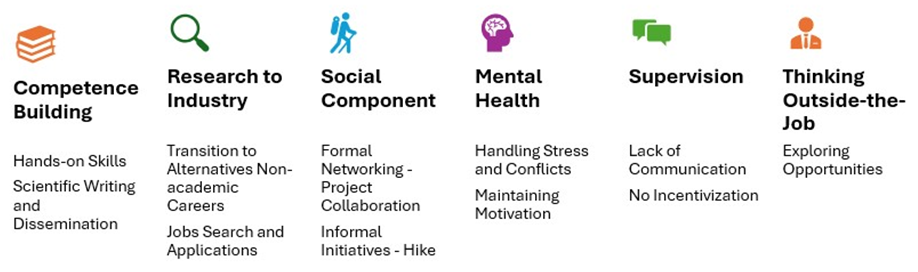
A survey that highlighted four key points and two challenges
JRG conducted a survey targeting the DLN Research School (DLNRS) members at the DLN conference in 2023. The survey aimed to determine the perspective of early-career researchers on their research experiences and the ways DLN can contribute towards their fulfillment. The survey highlighted four key points:
1. Competence Building
The early-career researchers asked DLN to facilitate knowledge acquisition through specific courses, including data analysis, bioinformatics, AI, and domain-specific skills. They also call for training in academic skills such as project management, academic writing, and disseminating research outcomes, alongside soft skills that are valuable beyond the academic context, such as presentation abilities, conflict resolution, and effective communication with various stakeholders. Moreover, they emphasize the need for proficiency in grant writing applications. This skill transcends the mere acquisition of funding to encompass the articulation of research impact and the advancement of research that is both exciting and beneficial to researchers and society at large. Finally, numerous early-career researchers actively seek career development advice within the academic environment and broader professional contexts.
2. Research to Industry
DLN can assist researchers, particularly those facing challenges transitioning from academia to other sectors. A substantial demand exists for guidance aimed at PhDs, postdocs, and researchers on navigating the shift from research to the commercialization of products and from scientific inquiry to startups, business ventures, or industry. Responses revealed a keen interest in innovation and entrepreneurship. Additionally, respondents underscored the importance of understanding the competencies that companies seek. They also express an eagerness for information on job openings and propose the organization of career fairs at the PhD and postdoc levels with industry representatives. The interaction between early-career researchers and commercial entities is in high demand. Early-career researchers greatly value internships coordinated by DLN for PhDs and advocate for an increase in such opportunities. They also observed a lack of internship options for postdocs and researchers, prompting a call for DLN to facilitate these opportunities.
3. Social component
Responses about networking emerged prominently. Respondents defined networking as actively engaging with colleagues and other members of DLN for research collaboration, social interaction, and exchanging ideas with peers working on analogous research topics or facing comparable challenges. Such networking could be formal or informal, like organizing a hike.
4. Mental health
Finally, and of critical importance, is the topic of mental health, which is essential to the success of PhDs and postdocs. The significance of this issue cannot be overstated. Early-career researchers require support in managing stress, resolving conflicts, and sustaining motivation. The first step to solving a problem is to accept the problem. However, with the normalization of mental health issues, early-career researchers have accepted these challenges as an unchangeable aspect of their professional experience. Therefore, there is a need to integrate and institutionalize mental health activities so that acknowledging mental health problems and seeking help becomes easier and more accessible for early-career researchers.
Building on the points raised by DLNRS members, JRG would like to highlight the long-known challenges that early-career researchers face:
1. Supervision
Supervision is a continuous challenge for many PhDs and postdocs: good supervision is not rewarded, and bad supervision is not sanctioned. There is a lack of incentives for supervisors to become better leaders and mentors, which needs rectification. While there are instances of supervisors who prioritize research outcomes over the research process and the career development of their PhDs and postdocs, we also acknowledge the inspiring supervisors dedicated to the holistic growth of their supervisees. To break this long-standing cycle, it is imperative to establish a system that motivates supervisors to excel as leaders and mentors, ensuring the well-being and professional advancement of early-career researchers.
2. Thinking Outside the Job
JRG encourages students to invest time and resources in exploring opportunities and initiatives offered by various institutions and screening the sector landscape. Multiple initiatives in Norway support researchers, and everyone should benefit from them. The JRG intends to capitalize on a range of initiatives already existing within and across institutions and at the societal level - many of which remain unknown or ignored - to improve the career prospects of early career research members of DLN.
Please contact us if you have any concerns or want to share information! You can find the contact details of each JRG member here.
Yours,
Junior Resource Group (JRG)