
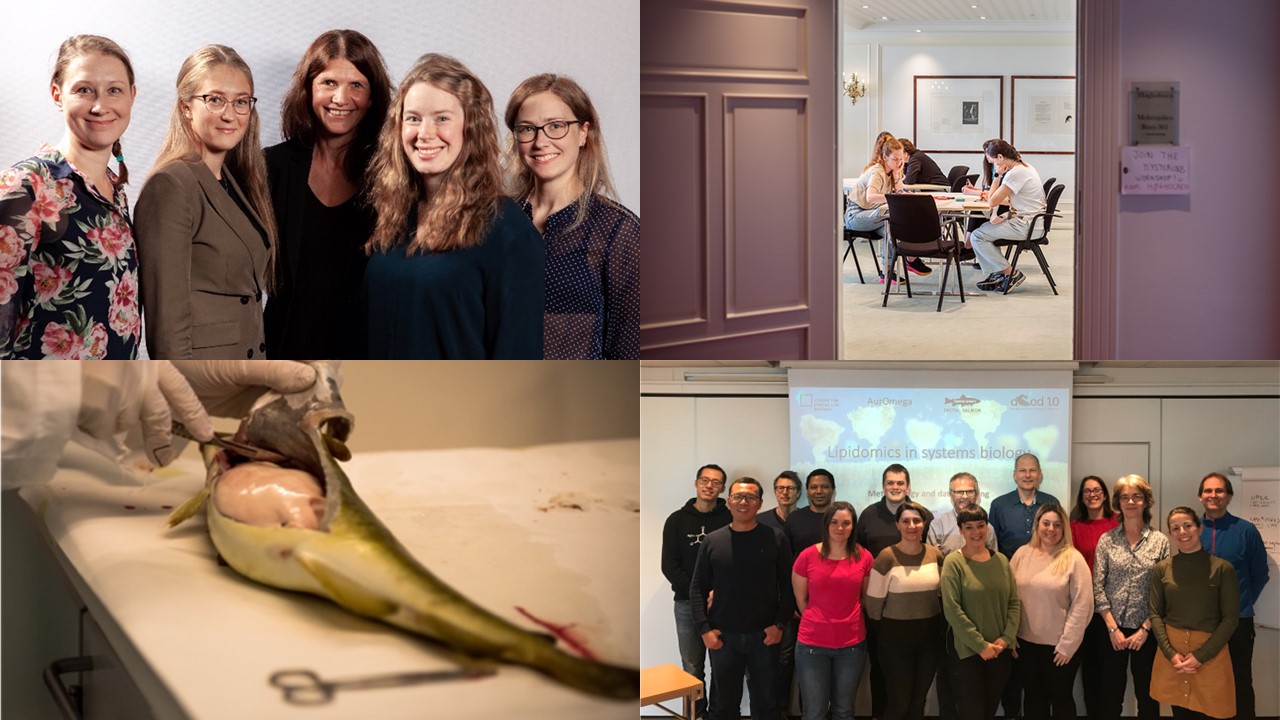
The best thing about the cross-project call was to "...work together with researchers from other projects, and be able to try out new ideas that arise when we meet researchers with different backgrounds and different expertise,” according to Hanne Haslene-Hox, senior researcher at SINTEF.
A cross-project and the start of something new
Rune Kleppe, who worked at the Centre before and who is now a Researcher at Helse Bergen explains that "Cross-project activity really allows the projects to interact directly and to exchange methodological competences and to do some small pilots that could eventually lead to a deeper collaboration. With the large project portfolio of DLN, the possibilities are only limited by knowledge about what goes on in the different projects."
Anders Goksøyr, a professor focusing on environmental toxicology at University of Bergen, explains that sometimes collaboration like this becomes more long-term: “In our case, a DLN cross-project funding several years ago has led to collaboration on a 3-year TechnoConvergence project that was funded last year, the XENOSENSE project.”
The benefits of working cross-project
When projects dCod 1.0 and AurOmega worked together on lipidomics, they each got new perspectives and were able to help each other along the way. In dCod 1.0 and DigiSal’s cooperation, the researchers "…experienced first-hand the positive and synergistic effects that can arise from cross-project collaboration" Cooperation between 3DLife and dCod 1.0 resulted in a collaboration where knowledge from cultivating human cells in 3-dimensional (3D) matrices has improved cultivation of whale cells used for testing environmental pollutants in the sea. The researchers learned that the 3D method was no advantage for cod liver tissue, but a success for whale cells.
Recommendations for successful cross-project work
Cross-project works is not necessarily easy. Else Marit Inderberg of CellFit recommends projects who want to apply to "Try to be as concrete as possible with respect to short-term outcomes and follow-up projects."
Hanne Haslene-Hox, who is a part of 3DLife, explains that “Communication is key – and context is important. We have a lot of unconscious knowledge that is hard to transfer and communicate. Being able to interact, observe and exchange good practices is important for the success of a cross-project.”
Anders Goksøyr says that “the most difficult part is to be willing to spend time trying to explain and understand each other’s field of research,” but the aha-moment comes when “you realize that there is much more in common between different projects and the problems we sometimes face, than one should believe at the outset.”
Application deadline: November 1st, 2024
Maximum funding for each application: 50,000 NOK
Total available funding in the call: 75,000 NOK