
Typical cell cultures are useful model systems, but lack several important aspects of normal tissues, such as their 3-dimensional expansion. The MEDIATE project uses neuronal cell culture models to understand more about how aberrancies in amino acid homeostasis found in metabolic disorders can affect neurotransmitter synthesis. Refining our model systems will allow us to better mimic the conditions in the brain, still within a controllable environment. In metabolic diseases such as the liver diseases phenylketonuria and tyrosinemia, extreme levels of the amino acids phenylalanine and tyrosine accumulate in the blood. This largely affects the transport and synthesis of monoamines in the brain, which again affects several cognitive processes and development of the brain. In the MEDIATE project, one major interest has been to understand more about underlying mechanisms of how high levels of tyrosine, the precursor of dopamine, leads to dopamine deficiency and ADHD-like symptoms in tyrosinemia type 1 patients. To study this, we have been using a well-known neuronal cell model that synthesises dopamine, the PC12 cell. A 3D model would improve the validity of the cell model and the expertise in the 3DLife project was a natural partner in a pilot project to test the growth in 3D. For 3DLife, it was interesting to test neuronal cells in the alginate scaffolds, as this had not been tested before.
In this cross-collaboration project between 3DLife and MEDIATE, we successfully cultured neuronal cells within three-dimensional (3D) alginate hydrogel scaffolds. Knowledge gained from the 3DLife project was directly applicable to neuronal cells, where biofunctionalized alginate hydrogels were the prime material of choice. This was coupled with confocal imaging techniques to enable us to image neuronal cells within the hydrogels in detail. Laboratory work was mainly conducted at SINTEF and NTNU upon receiving cells from the MEDIATE project in Bergen. In this study, cell viability and cell morphology of PC12 cells were assessed with cells seeded, both on the surface of (2D) and within (3D) hydrogels functionalised with cell adhesive motifs (RGD). Finally, we attempted to stimulate neurite outgrowth using Nerve Growth Factor (NGF) and a cell permeable cAMP analog (cAMP).
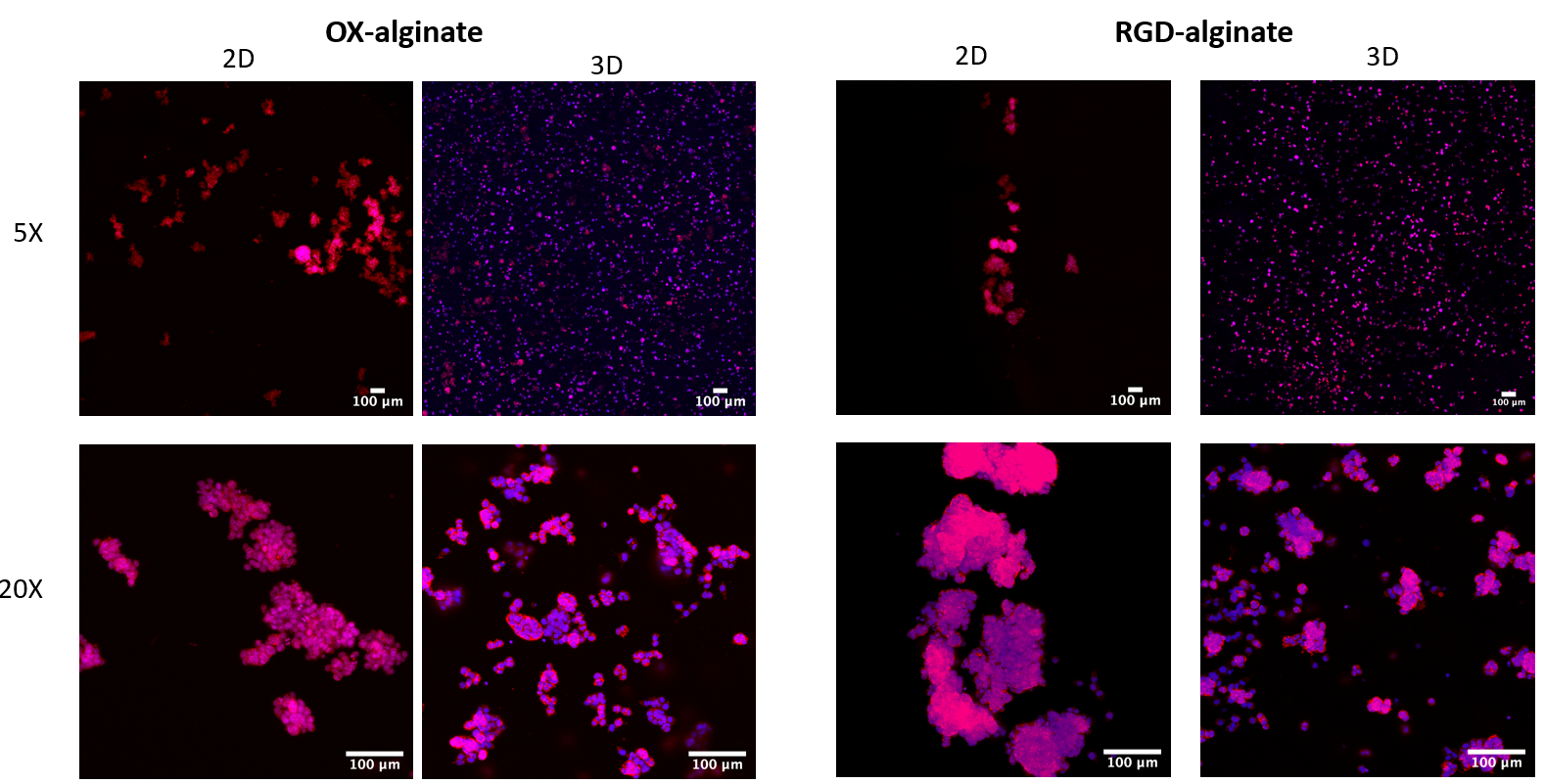
Figure 1 highlights the morphology of PC12 cells when seeded both on (2D) and in (3D) alginate hydrogels. It is evident that the cells tend to form clusters and lack any neurite extensions.
In this collaborative project, we were able to maintain a high viability of PC12 cells within alginate hydrogels, both with and without the presence of RGD. However, further optimisation is required to successfully stimulate differentiation and generate neurite outgrowths from the PC12 cells within these hydrogels. Alternate stimulants and cell adhesive motifs specific to neuronal cells that would aid the formation of neurites is should be tested in the future. Finally, exploring the effects of cell number and cultivation times could provide insight into the specific 3D culture conditions required to support differentiation of these neuro-endocrine cells to generate extended neurite projections.
Participants in the pilot project was researcher Aman Chahal and senior researcher Hanne Haslene-Hox from the 3DLife project and research prof. Rune Kleppe from the MEDIATE project. We are happy for the support from DLN to run such a pilot project and for being part of the project community of DLN with such wide range of expertises.