
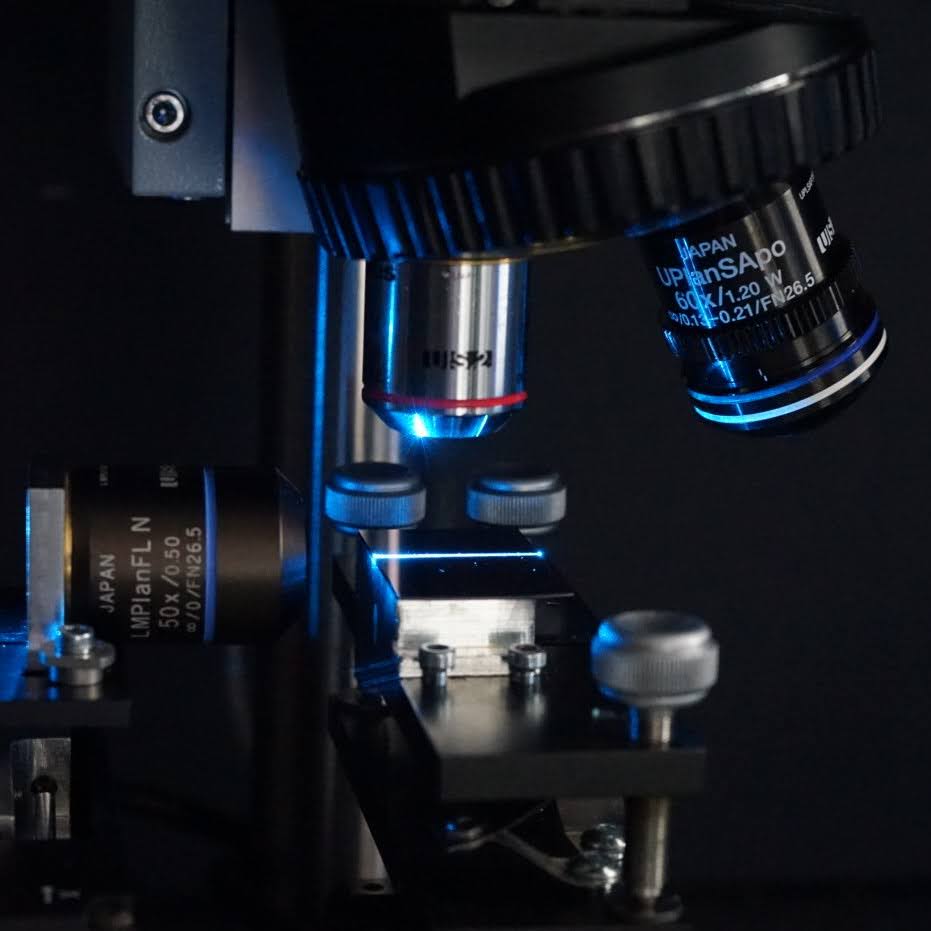
The EV-LiquidBiopsy project investigates a type of extracellular vesicles (EVs) released by cells into body fluids such as blood and urine. These encapsulated packages of molecules can reveal biomarkers of cancer, and might help the diagnosis and targeted treatment. However, with their small size of 30-130 nm in diameter, EVs are challenging to visualize using standard optical microscopes due to their limit of resolution (around 200 nm). Interestingly, the Nano-Chip project develops advanced super-resolution optical microscopes that can visualize structures in the nano range. Their method is based on label-free quantitative phase microscopy and label-free light scattering method based on photonic-chip.
Together, these projects applied for DLNs cross-project funding to investigate to which extent the technologies available at Nano-Chip could be applied for the visualization of the nanovesicles investigated in EV-LiquidBiopsy.
The cross-project activities included digital meetings to plan the experimental activities, a visit of EV-LiquidBiopsy, located at Oslo University Hospital, to the home institution of Nano-Chip, University of Tromsø, to perform the experiments, and a meeting to discuss the results obtained and plan future collaboration. Thus, the research projects exchanged both ideas, experiences, and competencies, as well as allowed for a short research stay for a postdoc in EV-LiquidBiopsy.
The experiments obtained promising results, showing that EVs can be visualized with the advance label-free optical microscopy approaches developed by Nano-Chip. Based on these results, the projects are planning follow-up experiments.
“We think that DLN funding for cross-project activities is a perfect way to find research areas where different DLN projects can contribute from different perspectives.”
- EV-Liquid-Biopsy project leader Alicia Llorente.
Involved researchers:

Alicia Llorente (Oslo University Hospital)

Balpreet Singh Ahluwalia (University of Tromsø)