
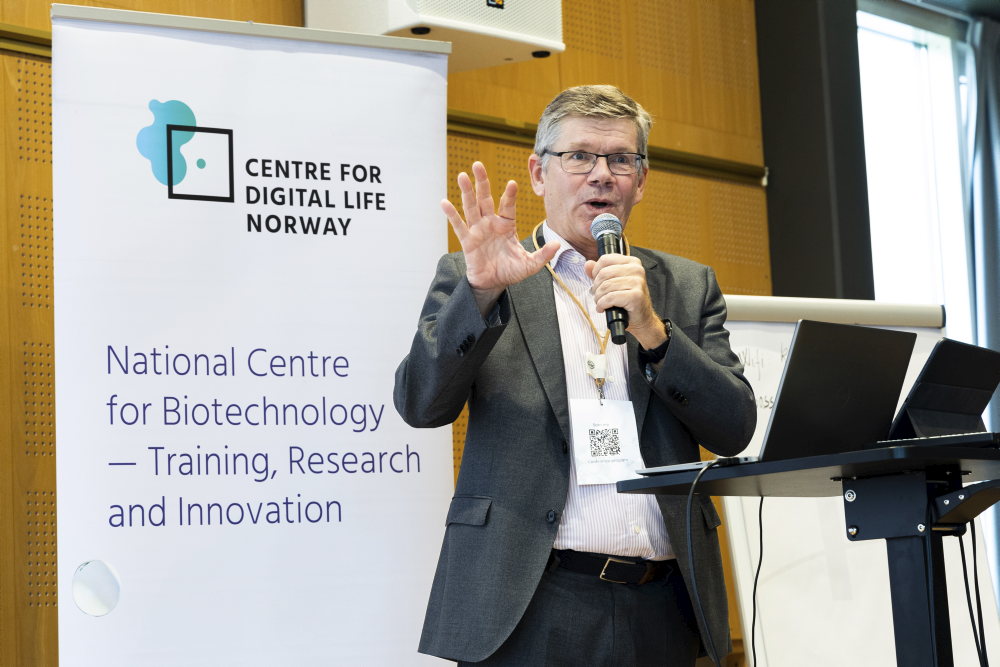
It’s very nice to be here. It’s a bit exciting because I haven’t been involved in this field for a while, and to come back after many years and see what you have achieved is truly interesting. I’m very happy to be here and honored to have been invited. It’s a great pleasure to welcome you all to this conference.
I had the honor of being the first chair of the board when this initiative began back in 2016, under the strategic initiative of the Norwegian Research Council, Digital Life Convergence for Innovation. It emerged as part of a long-term investment in interdisciplinary research, aiming to create synergies between biotechnology and digital fields such as computer science, mathematics, and statistics. The vision was to address major societal challenges in health, the environment, and industry by linking research and innovation.
The Research Council of Norway has done an outstanding job in supporting Digital Life Norway over many years, building a broad portfolio of interdisciplinary research projects. I believe this was—and still is—a brave and important initiative, inspired partly by similar initiatives around the world. The elements of success we see today have spread widely throughout our national research system.
True interdisciplinarity is happening here at the intersection of enabling technologies: biotechnology, nanotechnology, ICT, and AI, which is of course a game-changer. It is breaking down barriers, often cultural or linguistic, allowing for real convergence. Though this takes time, the potential rewards are huge.
Today, we have a community in Norway of scientifically "multilingual" people—scientists who can understand each other across fields, which is no small feat. I’m a materials chemist, and even I find it difficult at times to communicate with physicists. Different languages, different approaches to solving problems—but that’s why being scientifically multilingual is so valuable.
This convergence is not just across disciplines but also outside of academia. Cross-sectoral interaction is incredibly important, creating an ecosystem where different people and businesses play different roles. It’s not about turning researchers into business people, or vice versa, but about bringing them closer together to ensure interaction on the path to concrete innovation.
Innovation is not a linear process, so constant interaction is essential. A community of close “neighbors,” if you will, who interact regularly and take interest in each other's work helps ensure that basic research is translated into innovation and entrepreneurship more quickly. This is something we need in Europe.
I’m sure many of you have read or heard about the recent report by Mario Draghi on European competitiveness, which has gained considerable attention. It highlights how Europe is increasingly lagging behind, particularly in complex, new innovations at the forefront of science. Draghi calls for doubling the investment in science, knowing that one euro invested in Horizon 2020 returned five euros to the European community. He also strongly advocates for basic science and disruptive innovation based on it, which aligns with the vision of Digital Life Norway.
This initiative has undoubtedly been a step in the right direction for Norway, and its influence is spreading. We see similar ideas emerging more broadly within our research ecosystem. For example, when we develop innovation districts. Oslo Science City and the new Life Sciences building planned in Oslo are grounded in similar principles. The building will be inhabited by the University of Oslo and Oslo University Hospital. It is a new way of thinking—and it is necessary. Through this we will reach convergence to secure world-leading research which often occur at interfaces between disciplines.
One of the things I’m particularly pleased to see is the attention given to supporting research talent. It is wonderful to see so many young people in the audience today. I believe the center has been proactive in fostering career development and planning for young researchers, which is essential both nationally and in Europe. As the European Research Area grows, we must continue to focus on this, and I’m happy to see that this will remain a priority in the coming years.
So, a special warm welcome to the younger researchers attending the conference. Your enthusiasm, fresh perspectives, and dedication will be the driving forces behind the future of biotechnology in Norway. You are important, and you are at the beginning of what will hopefully be long and fruitful careers in science and innovation.
Please remember that the journey of discovery is just as important as the destination. Embrace the challenges, celebrate your successes—something we do not do enough of in Norway—and help each other through difficult times. Science can be challenging, with ups and downs before reaching the final answer. Never stop asking questions.
It is also important to acknowledge the work being done around responsible research, data management, and reaching out to society more effectively. Public trust is essential to gaining support for large investments in science, education, and innovation. We must ensure that our projects and behavior adhere to the highest standards of research integrity and ethics.
This is especially critical in today’s competitive global landscape, where the temptation to cut corners can be strong. We need to meet across institutions, share insights, discuss dilemmas, involve civil society, and learn from one another. Through this, we can maintain a healthy balance between collaboration and competition. Both are necessary for progress.
When Digital Life Norway was initiated, some expected a physical center where researchers from different disciplines would come together. Instead, it has largely become a virtual platform for collaboration, networking, and activities spread across the country. This decentralized structure has proven to be a strength, allowing for the inclusion of researchers from a broad range of institutions and fields.
And now, the important question: What’s next?
As Digital Life Norway approaches its end, we must reflect on what we will miss. I don’t have all the answers—you will need to determine what we need to continue supporting and how. The absence of a dedicated national meeting place like this may be felt, as it has been an invaluable arena for sharing knowledge, building networks, and discussing strategic issues.
We may need to find new ways to continue some of these activities. I’m sure this will be a topic of discussion at different universities and institutions in the weeks and months ahead. Digital Life Norway has made Norway feel smaller, bringing together researchers from across the country.
In conclusion, Digital Life Norway has been a great success. Although it is coming to an end, its legacy will live on in the knowledge created, the networks established, and the cultural change it has nurtured.
It is truly a pleasure to be here and see what you’ve accomplished over the past decade. Congratulations to you all. And while I know we shouldn’t single anyone out, I do want to take a moment to acknowledge Trygve [Brautaset], who has done a tremendous job throughout this entire process.
Thank you, Trygve, and congratulations to everyone. Welcome, and it’s great to see you all here today.