
This cool technology traces its roots back to a creative experiment where Beethoven’s symphony was mixed with Einstein’s speech. Scientists used this mix to demonstrate that using some clever math, they could separate music from speech. This trick led to the development of MUSIC, a special formula used in the 1980s to help radars detect where cars or planes were coming from.
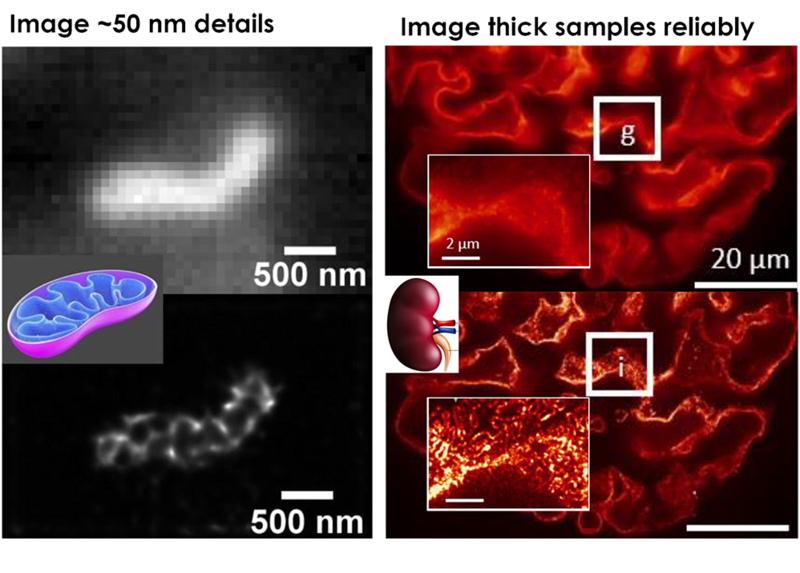
Fast forward a few decades, and MUSIC evolved into MUSICAL for use in optical microscopes [1]. Instead of finding cars or planes, MUSICAL detects the direction of tiny light particles, called photons, as they move towards a microscope’s camera. It’s a bit like having a superhero’s vision: MUSICAL can see where these photons come from, allowing scientists to create images of tiny biological samples with amazing clarity—three times clearer than what was previously possible with the same microscopes!
However, there's a catch. Photons move incredibly fast, and capturing them in action is no small feat. To make the most of MUSICAL, scientists need really fast cameras and even faster computing power to process what the cameras capture.
Recognizing the potential of this technology, Digital Life Norway and the Research Council of Norway have invested in making MUSICAL even better [2-4]. They have funded projects at UiT The Arctic University of Norway to develop new, speedy MUSICAL equipment that can keep up with the fast-moving photons. This high-tech gear will help scientists get super-detailed images quickly, making it easier to study diseases and our health in unprecedented ways.
In short, MUSICAL is turning ordinary microscopes into super-powered tools for discovery, promising a future where we can see the microscopic world like never before. And it all started with mixing a bit of Beethoven with Einstein!
[1] Agarwal, Krishna, and Radek Macháň. "Multiple signal classification algorithm for super-resolution fluorescence microscopy." Nature communications 7.1 (2016): 13752.
[2] https://www.digitallifenorway.org/competence-areas/innovation/innovation-roadmap/index.html
[3] https://prosjektbanken.forskningsradet.no/project/FORISS/347244
[4] “Lightweight super-resolution imaging” (id. 349956). https://www.forskningsradet.no/utlysninger/2023/verifisering/#results
* A little help from Chat GPT version 4.0 is acknowledged.