
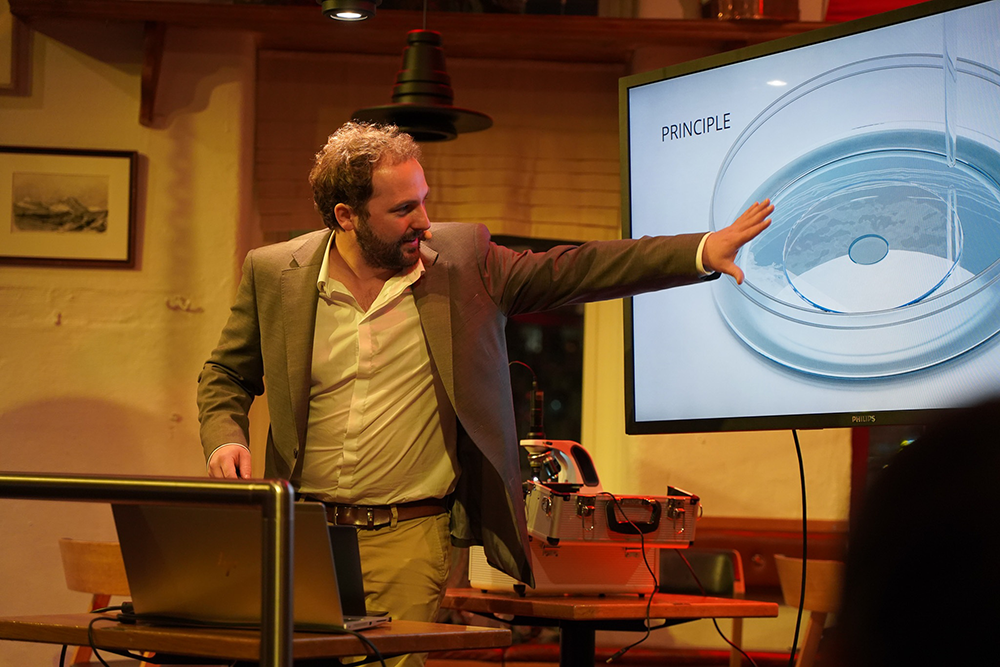
The NANOSPACER device is a transparent coverslip paired with a bottom substrate, creating a precise nano-sized distance between those layers. The design enables high-resolution particle observation at the nanoscale, offering potential for a range of scientific and industrial applications.
Awarded the RCN verification grant
The Research Council of Norway has a commercialization project opportunity which researchers can apply for together with their institution’s Technology Transfer Office (TTO) (Verifisering – Kommersialisering fra offentlig finansiert forskning). NANOSPACER's project lead is postdoc Oliver Vanderpoorten at the Department of Physics and Technology at UiT, is working together with Norinnova business developers Magnus Seppola, Mayank Roy, and Bronwyn Smithies to bring this technology to market.
Future Impact and Commercialization
With the support of this grant, Vanderpoorten and his team will establish a laboratory and lay the foundation for a startup. Their vision is to scale the fabrication of NANOSPACER devices for multiple applications, ensuring that this technology reaches its full potential across various industries.
Advancing Nanobubble Detection with SINTEF Ocean
NANOSPACER is currently being tested in collaboration with Senior Research Scientist Roman Netzer at SINTEF Ocean for the detection of nanobubbles and its application for aquaculture water quality monitoring. The long-term goal is to use this technology for studying nanobubbles in land-based fish farming tanks. Early tests have shown promising results, and further development is underway.
Nanobubbles have a high potential for improving water quality by reducing bacterial presence and biofilm formation while increasing fish health and therefore yield. This makes them a valuable method for maintaining a healthy aquaculture environment. In addition, nanobubble technology offers a significant reduction in energy and oxygen consumption, thereby increasing the sustainability of land-based aquaculture. However, nanobubbles require specific conditions to form, and verifying their presence in real-world settings demands a cost-effective and portable testing method. This is where NANOSPACER steps in!