
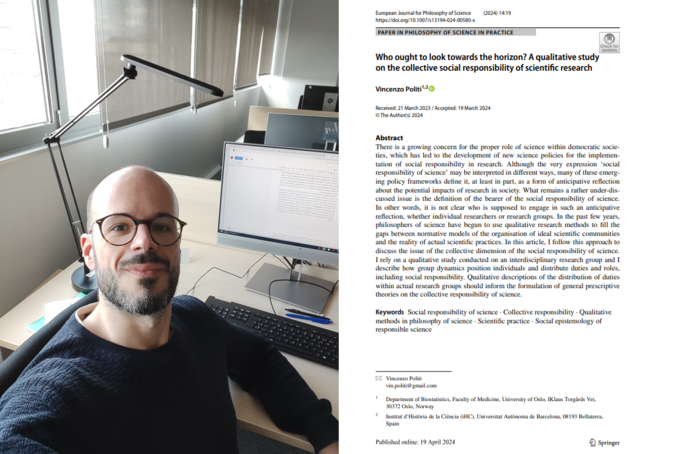
The article can be downloaded from here: Who ought to look towards the horizon? A qualitative study on the collective social responsibility of scientific research | European Journal for Philosophy of Science (springer.com)
What was your role in PINpOINT? Were you an embedded philosopher? How was it?
I had a 2-year contract as a postdoctoral researcher within PINpOINT. My position was associated with the work-package about RRI. Since RRI is an emerging policy framework, there are not many ‘RRI experts’ around. I do not even consider myself as an ‘RRI expert’ but, before coming to Norway, I had accumulated some experience with RRI. Besides, the desirability of having professionalised ‘experts’ in RRI is questionable, at least in my view, since there is the risk that ‘responsibility’ gets fully delegated to the RRI experts, leaving the research culture unchanged. In any case, as a philosopher of science, I was very glad to have the opportunity to work with natural scientists and observe first-hand how research is conducted.
I like to think that I was an ‘embedded philosopher’ to some extent. However, there were some serious obstacles to full embeddedness. First, I joined the project during the COVID pandemic and there was a lockdown for quite some time. Second, the project is indeed ‘multi-site’: the Department of Biostatistics and the Institute of Cancer Research are kilometres apart, a fact that poses an obstacle to embeddedness. Finally, even though I was under contract with the Department of Biostatistics, my office was at the Department of Philosophy, Classics, History of Art and Ideas (UiO). These challenges made it difficult to socialise with both the biostatisticians and the philosophers, to the point that I didn’t feel like belonging to either the departments. Actually, sometimes I felt alienated from both: philosophers never truly figured me out, while for the biostatisticians I was just the guy who showed up every now and then. I talked about this to prof. Arnoldo Frigessi (the head of the Department of Biostatistics and one of the PIs of the project). I suggested that if, in the future, they collaborate again with scholars from the Humanities, and depending on the nature of the project, maybe they should be situated in proximity of the other team members. I regret talking about these things with Arnoldo only towards the end of my appointment.
In any case, since getting acquainted with team members was paramount to my work, I frequently visited their labs and offices, as well as attended the monthly project meetings. I remember a day spent with Pilar Ayuda-Durán while she was performing an experiment with ‘the robot’ (a drug mixer that gives different drug combinations in different doses to cancerous cells). I also had some meetings with the PIs (Kjetil Taskén, Jorrit Enserink, and Arnoldo Frigessi) who explained to me the details of the project. Then I got some basics of statistical modelling thanks to the careful explanations of Alvaro Köhn-Luque. All these researchers made a lot of effort to welcome me in the team and to explain very difficult concepts and processes in a way that I could understand. I must say that, despite the practical difficulties that I talked about, the process of socialisation with scientists was very smooth and, overall, a very nice experience.
How did you become interested in RRI?
In philosophy of science, there is a huge ongoing debate about whether science is agnostic/devoid of values, or whether it is more value-laden. The different perspectives (value-freedom vs. value-ladenness) entail different conceptions of ‘scientific objectivity’. For the supporters of the value-free perspective, scientific objectivity corresponds to absolute neutrality without a subjective standpoint to so as to obtain the ‘pure facts’. The supporters of the value-ladenness perspective argue that rather than being an obstacle, different standpoints actually enrich scientific objectivity.
Of course, I already had an interest in the philosophical discussion of these concepts. Previously, I worked at the Commissariat à l’Énergie Atomique et aux énergies alternatives (CEA) in Paris, for a Horizon2020 project on RRI called RRI-Practice. Here, scholars from various disciplines analysed how RRI was conceptualised in research funding and research institutions in 12 different EU and extra-EU nations. We did a comparative analysis of 12 national case studies on two different RRI ‘keys´.
We published an article where we talked about the ‘distribution of ethical labour’ within the scientific community. This inspired me to look into how the cognitive skills and epistemic attitudes of individual scientists (in scientific communities and research groups) differ. I also explored how this shaped knowledge production and the distribution of collective responsibility of science.
Can you sum up your main finding in a sentence or three?
Scientists at PINpOINT care a lot about societal needs, but they don’t know how to contribute to society more actively, or they don’t feel adequate enough to do the task.
Scientists from different disciplines may have different conceptions of what ‘social responsibility’ means.
Some scientists could be very good philosophers of science! Instead of blindly following a protocol, they may have very subtle and sophisticated views about foundational and methodological issues. It’s just that they are not used to discussing them openly or with enough depth. (This should be a lesson for some analysts of science, like philosophers, sociologists, or historians of science, who think that they understand science more than scientists themselves.)
What was most interesting, in your point of view?
One interesting finding is that researchers assume that others share their disciplinary knowledge. During the monthly meetings, for instance, I observed that researchers from different disciplines struggled to communicate effectively. One of the researchers I interviewed said that in interdisciplinary projects there are problems of ‘translation’. I take this expression to be metaphorical: the problem is not understanding a different ‘language’, but understanding different methodologies or even different ways to conceptualise or prioritise some problems. Yet, at the same time, all these people with different backgrounds and different ‘(scientific) languages’ are working together on the same project. And the most interesting thing, for me personally and as a philosopher, is that even though I am not a natural scientist, and even though I was the one struggling the most with getting all the different technical languages, somehow I could understand the root of the eventual cases of interdisciplinary miscommunication. So, in the end, it may be true that interaction between scientists from the social and natural sciences could be fruitful. However, to be even more fruitful, it would surely require longer than the time I spent on PINpOINT.
..and what was surprising to you?
First of all, I am surprised at myself! It took me a long time to understand what was going on at PINpOINT and how this research worked. I spent at least 6 months visiting labs, talking to people, and reading articles I did not entirely understand. I felt unproductive and also kind of useless. Imagine that you ask people what they do for a living, and they say: “We’re trying to cure cancer”. Then you think about yourself: a philosopher who spends all day reading and writing. I mean, in such a situation you start questioning the point of what you do. Then I remembered that I am not a natural scientist, and that there’s nothing wrong with that. I stopped feeling inferior or useless in comparison to natural scientists, because I was not one of them, I was dealing with different things and, in the end, everyone has their role and gives their contribution in different ways.
I was also positively surprised with how the researchers at PINpOINT were eager to collaborate with a philosopher. They seemed curious about me and what I had to say. I think that, in places like Norway, but also the UK, the Netherlands, and other places in Northern Europe, scientists are more used to the idea of inter- and transdisciplinarity. This is not the case everywhere.
Besides the distribution of responsibility, what do you think is relevant for the RRI context?
RRI is a multifaceted concept. Scholars in the science policy literature even discuss whether RRI is about the ‘process’ or the ‘product’ of research, development, and innovation. In short, there are many important sides to RRI, and it would be difficult to say what is ‘the’ most important of them all.
However, I am very interested, and somehow concerned, with the idea of ‘public engagement’. In theory, proponents of RRI regard public engagement as something more complex than informing the public. Public engagement should be a bidirectional dialogue. It is not about natural scientists telling the public how many beautiful discoveries they are making. They should instead be receptive to the doubts and questions of concerned citizens. While some philosophers say that responsibility involves an ability to have a response, or ‘response-ability’, putting this in practice is less obvious. At the same time, I also wonder whether it is really ‘responsible’ to communicate everything to the public. We tend to think that natural scientists live in an ‘ivory tower’ and are not receptive to the public. But is the public receptive to natural scientists? In short, I think that public engagement is important and a timely initiative, but it needs to be considered carefully. Public engagement is good, but the Devil is in the details.