
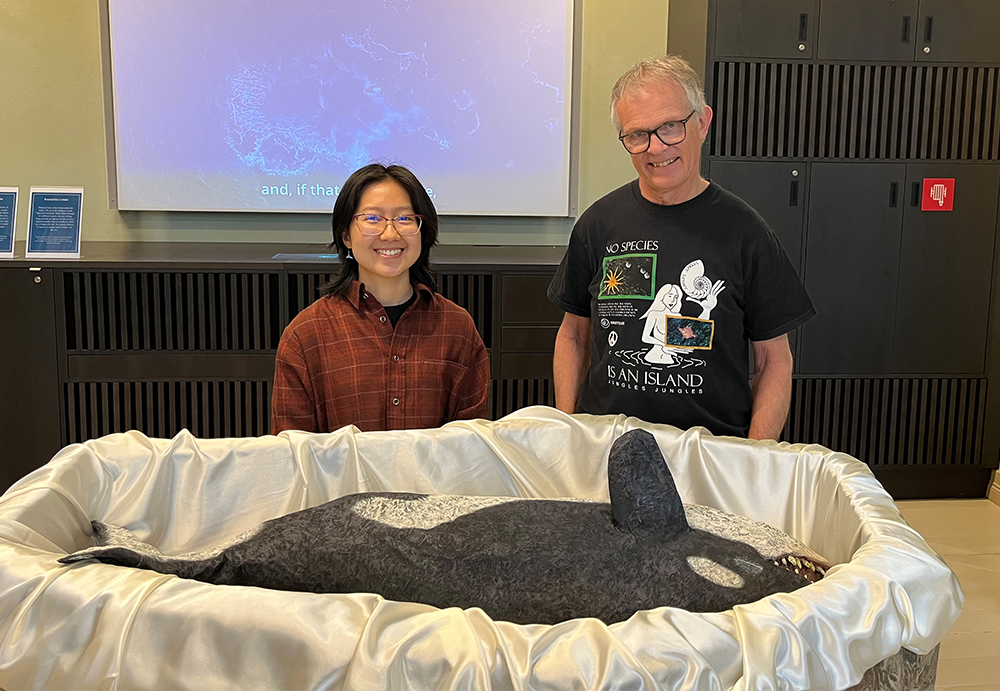
When visitors entered the University Museum of Bergen this spring during One Ocean Week, they were met with an unexpected sight: a coffin cradling an artistic rendition of the orca named Elida. The model and coffin were created by Yasemin Orhan, a Master’s student in Contemporary Art Practice at the University of Bergen. The exhibit, part science, part storytelling, and part memorial, was created by Marma-detox member and Fulbright scholar Audrey Su together with Marma-detox project lead Anders Goksøyr. Audrey spent the past year in Bergen translating complex environmental science into powerful public education.
Fearless science communication
“Audrey has made an impressive contribution to the dissemination of research from our project this year,” said Anders Goksøyr, project lead at Marma-detox. “She fearlessly took on new challenges and contributed both to creating exhibitions and videos, and has collaborated with other institutions such as the University Museum of Bergen and The Whale. We are very fortunate to have had Audrey with us as a Fulbright student.”
The University museum exhibit centered around the story of Elida, a young killer whale containing high levels of environmental pollutants passed down from her mother. These pollutants accumulate in the ocean and in fatty tissues of marine mammals, which are then passed down by females to their offspring through their fat-rich milk and placentas. "Most people don’t know that these animals are born with pollutants already in their body," Audrey explained. "It’s not just something that builds up throughout the animal’s life; they are likely getting passed down through generations.”
Emotional and interactive 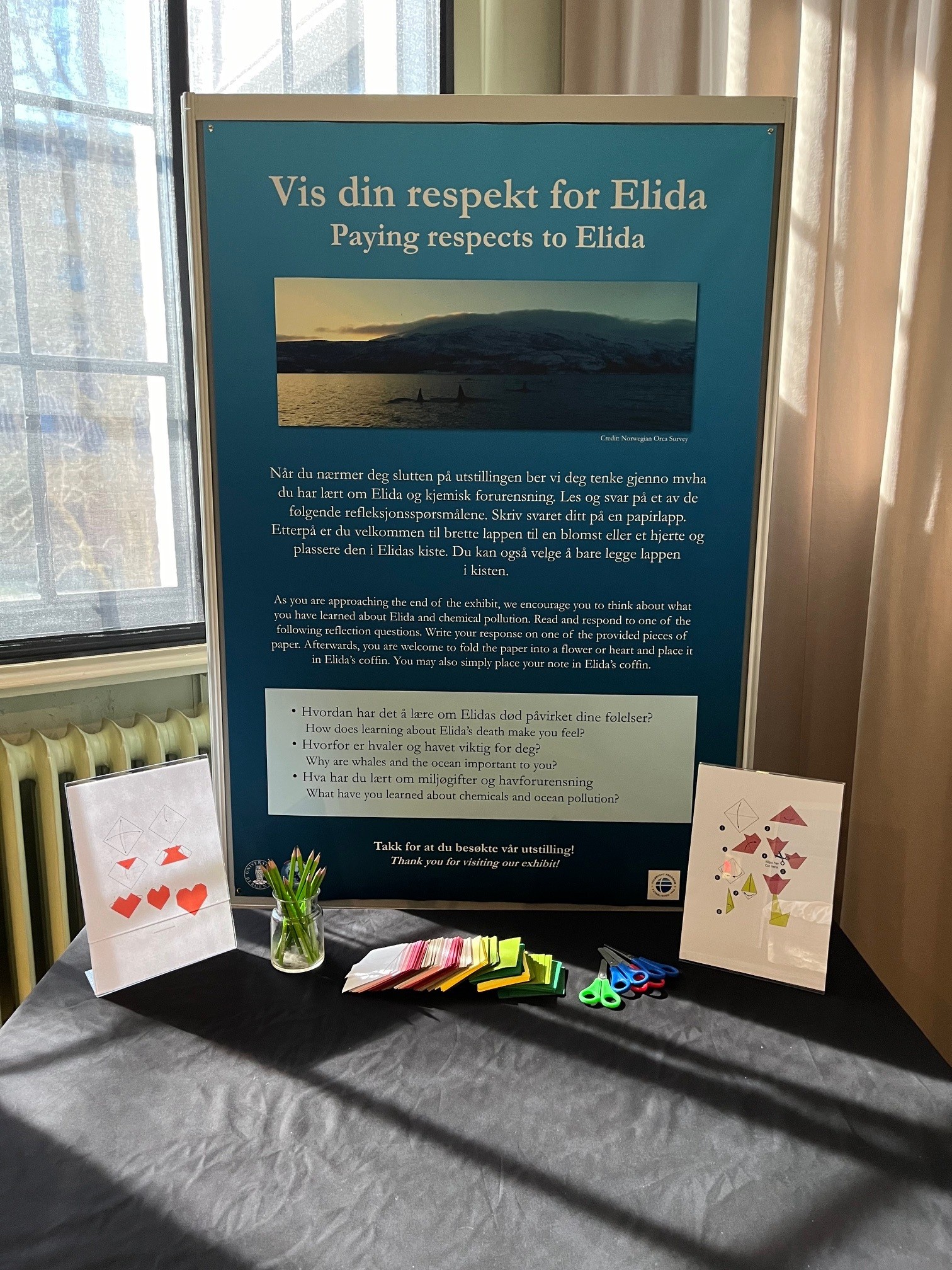
The exhibit was more than an educational showcase; it was an emotional and interactive experience. Visitors wrote notes of sympathy on origami flowers and hearts, laying them in the coffin as a tribute to Elida. “One child wrote, ‘You were only three, I hope you can rest now,’” Audrey recalled. “That really stuck with me.”
500 visitors
Over the course of One Ocean Week, the exhibit drew about 500 visitors, including a group of 120 education students. Audrey gave tours, answered questions, and introduced an interactive activity inspired by the Interdisciplinary Centre of Marine and Environmental Research (CIIMAR) in Portugal, one of Marma-Detox’s partners. This activity helped visitors connect the global issue of marine pollution to chemicals in everyday life. “I wanted to make the issue personal and relevant," she said. "It’s easy to ignore something that feels far away, but we are part of this story too.”
Creating spaces for people to learn
The exhibit also featured activities from an educational program on ocean health for schoolchildren, which Audrey helped develop. Children can engage with hands-on learning tools like plush marine animals filled with organ cutouts marked with white dots to represent chemical contamination. "It helped explain a complicated issue in a way they could see and understand," she said. Audrey’s degree is in Environment and Sustainability, with a concentration in wildlife conservation and education, and she has a passion for science communication. “I really enjoy designing exhibits and creating spaces for people to learn,” she said. “Ideally, when I go back to the U.S., I’d like to work as an educator or exhibit designer at a museum.”
In addition to the exhibit, Audrey made a video on how the projects Marma-detox and SLICE work with cell samples from whales. “I had never made videos before,” she admitted. The video has since caught the attention of multiple museums, including The Whale and Polaria, who have asked to include it in their own displays.
Flying start on research dissemination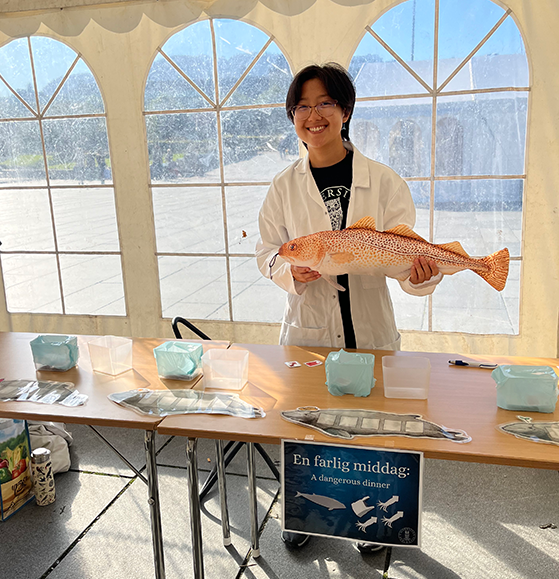
Audrey’s year at University of Bergen got off to a flying start: within a few weeks of arriving, she created an educational game about plastic pollution for Forskningsdagene in Bergen. The game was based on the whale that was found off the coast of Hordaland in 2017 with its stomach full of plastic, and simulated the risks marine animals face from ingesting plastic.
The exhibit remains this year
Though her time in Norway is drawing to a close, part of Audrey’s work will stay on a bit longer—the exhibit remains in the biology building lobby through the end of the year, and the children’s ocean health program will be run by museum educators going forward.