
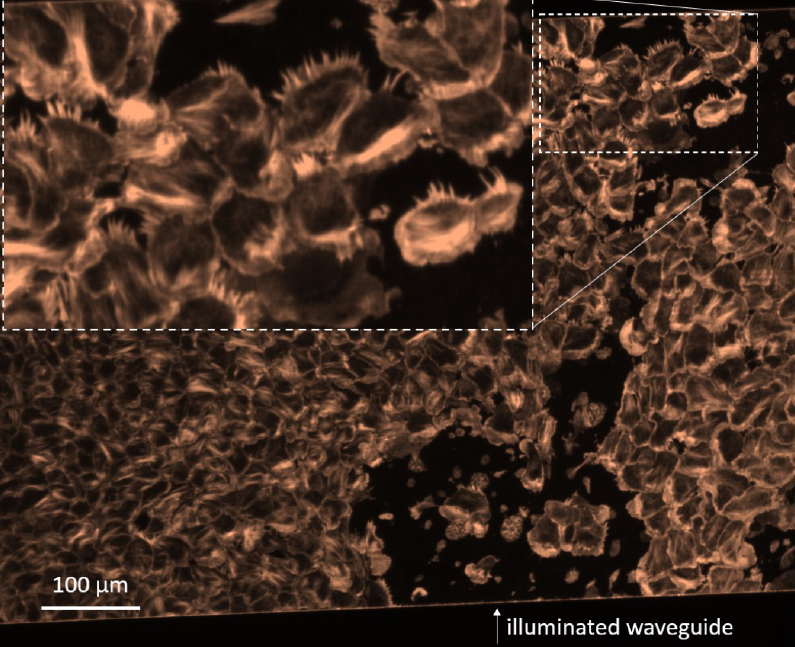
Here, the dataset was used to demonstrate a new super-resolution imaging technique exploiting the illumination variations introduced by sequentially exciting different waveguide modes (or illumination patterns) in the sample substrate (i.e., a photonic chip). The mode patterns can be added together to achieve a high contrast image of the surface layer (known as TIRF microscopy), or computationally reconstructed for super-resolution microscopy using the method MUSICAL as demonstrated in the mentioned article. The sample was fluorescently labelled for filamentous actin in salmon keratocytes harvested from scale samples.
Citation:
Opstad, Ida S., 2021, "Replication data for: Fluorescence fluctuation-based super-resolution microscopy using multimodal waveguided illumination", DataverseNO, V1