
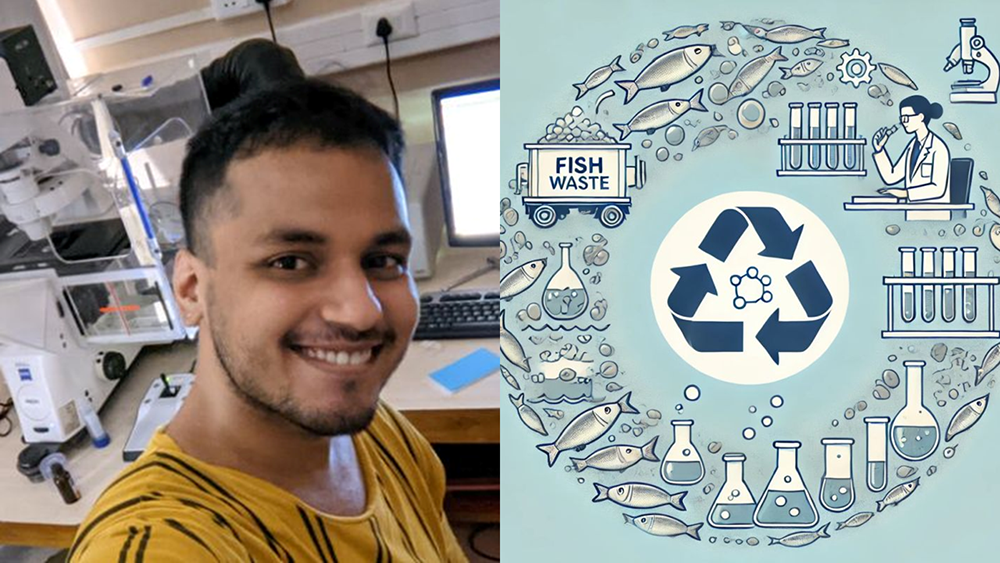
This is a pilot project that funds fundamental research which identifies routes of innovation. The MABIT-program is an industrial R&D program for marine biotechnology in northern Norway.
Biswajoy Ghosh
Biswajoy Ghosh is a researcher in Ultrasound, Microwaves and Optics in the Department of Physics and Technology at the UiT- The Arctic University of Norway. He is affiliated with the DLN project nanoRIPBefore he has worked to develop technologies to non-invasively diagnose cancer.
He used to work a lot on animals, and hated it. Therefore, today he works to replace animal testing, by researching engineered organ models. Viewing life unraveling its many mysteries under microscopes is his thing!
An effective circular economy model
Norway, one of the world's leading fish producers, generates significant amounts of waste. At present, this waste is either discarded as residual material or repurposed for low- to medium-value applications such as dietary supplements, packaging, and cosmetics. We propose transforming cold-water salmon fish waste into high-value biomedical products for healthcare applications, including cancer drug discovery and personalized medicine. This approach not only minimizes waste but also contributes to medical research, exemplifying an effective circular economy model.
Project at a Glance
- Funding: NOK 1 million
- Duration: April 2025 – March 2026
- Focus: Sustainable drug discovery using marine waste
- Impact: Enhancing innovation in biotech and reducing the need for animal testing
How it started
This grant would not have come about without Komal Aggarwal's activity for the Digital Life Norway Impact call, where she and Biswajoy Ghosh first aimed to explore the possibilities of improving arctic farming. However, there was a lot lost in translation between the fish farmers and the researchers. They needed field translators! The needs of the farmers were immediate, while the researchers were seeking long-term sustainable solutions to arctic farming problems. That could happen when they could find the right intermediaries between researchers and farmers.
"Just as we were about to give up, strategic changes to involve industry set things in motion, leading to unexpected growth beyond our expectations."
It was when Komal and Biswajoy started speaking to industry working with the farmers, such as Lerøy and the Biotech North cluster, that things started happening. Lerøy was looking for this kind of solution, and the Technology Transfer Office Norinnova saw potential and was very helpful.
The Impact call was designed to increase engagement between academic and non-academic communities, and this project really fits the bill! Biswajoy's research in microscopy is inherently global, but by seeing and acknowledging the local context, this project gains a distinct advantage.
Collaborators
This project is coordinated by Biswajoy at UiT – The Arctic University of Norway, but has important collaborators:
- Lerøy Seafood Group ASA (Providing logistics and raw materials)
- Norinnova AS (Innovation and commercialization support)
- Biotech North (Connecting him to a thriving biotech network)