
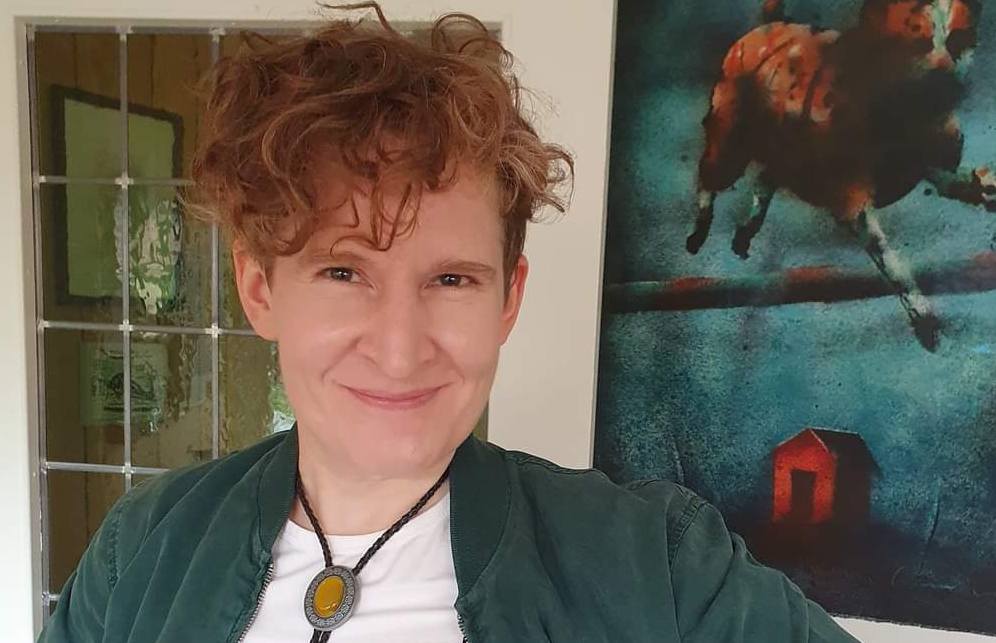
Ane Møller Gabrielsen currently works at NTNU Biblioteket. As she candidly puts it "my background is in Science and Technology Studies (STS) and Gender Studies. For some reason, this led to a PhD about dogs and how we as humans go about to make them fit into society. After working with RRI as a postdoc in an interdisciplinary project, I decided that academia was not for me, and I am now working as a senior research librarian."
The project she is referring to is the Crossover Research 2.0 project (CR2) funded by the Research Council of Norway. The aim of this project was to explore how a particular scientific community, the gene regulation community, could collaborate to make knowledge in this domain, computable. A key component of CR2 was to understand how such a collaboration could be shaped by the concept of RRI (see here to learn more about RRI) To this end, CR2 used the DLN project Druglogics (now Druglogics/PRESORT) as a use case. DrugLogics is a systems medicine project that is developing computational models to identify drug combinations for anti-cancer treatment. A premise for this type of modeling is that knowledge on gene regulatory processes should be available in a computable form. In this article, Ane shares her experience of working in the CR2 project and RRI.
1. What was your role in Crossover Research 2.0? How did you do your work?
My role in this endeavor was a bit unclear. The RRI part was described as developing an RRI strategy that would support scientific solutions and their ability to “withstand trials of moral engagement and scrutiny” through mapping the research infrastructures, but how this was to be done in practice was quite unclear. The overall idea was that all project participants were supposed to do RRI, this was not supposed to be left to the non-science scholars. While the scientific aim of the project was clearly stated, the RRI approach remained ambiguous throughout the project period. However, I found topics that seemed interesting to me and I spent my time in the project doing research on biocuration and biocurators.
2. How embedded in the research project, do you think, was your work?
My “embeddedness” in the project mostly consisted of participating in meetings and joining the scientists for conferences and events. My own work had, in my opinion, little to do with the main aims of the project.
3. What was most interesting in your work within the project?
I learned a lot about molecular biology which had always seemed as a fascinating field to me. The most interesting thing was actually to explore how the field developed from a history of science-perspective.
4. ...and what was most surprising?
The most surprising thing for me was all the manual labor and decision-making required for making seemingly neutral molecular information machine-readable. Furthermore, the level of uncertainty involved in molecular science was fascinating to me. There are so many unknowns and the scientists are very much aware of this and it doesn’t seem to bother them. But to me, who thought we basically knew almost everything by now, the uncertainty and lack of knowledge was intriguing.
5. What were the challenges you experienced in the process and how did you tackle them?
The lack of any clear idea or guidance on how I was supposed to do my RRI-work was quite challenging. The fact that I knew next to nothing about molecular biology or computational modeling also meant that I had to learn a lot before being able to understand what was going on, science-wise. My way of navigating this was to find my own topic which I could research using the tools I knew from my background in STS and gender studies.
6. How did you become interested in RRI?
I was not aware of RRI before joining the project as a postdoc. But as I started to read up on the topic I found it both quite interesting and quite confusing. My ideal RRI-project would probably be to deconstruct RRI discourse rather than trying to actually practice RRI …
Responsible Research and Innovation is an important part of our work in the Centre for Digital Life Norway. (Read more about RRI in DLN). To highlight the people working with RRI in DLN projects, and to make RRI more tangible and understandable, we have a series of articles from the vantage point of the RRI experts working in projects. Read more experiences here:
Whose responsibility is it anyway? An embedded philosopher’s study
7. Are you still interested in RRI?
The idea of RRI is great and the same goes for the intention of making RRI an integral part of the project and not an add-on. However, in practice, I see RRI projects usually ending up with people from the humanities and social sciences being tasked with facilitating workshops while the research and innovation is left to scientists. So when I see RRI pop up in project calls these days, I think to myself that this will be yet another futile attempt at interdisciplinarity.
Read some of Ane's research on biocuration
Gabrielsen, Ane Møller. (2023) Gendering data care: Curators, care, and computers in data-centric biology. Science as Culture
Gabrielsen, Ane Møller. (2020) Openness and trust in data-intensive science: the case of biocuration. Medicine, Health care and Philosophy