
Read the article:
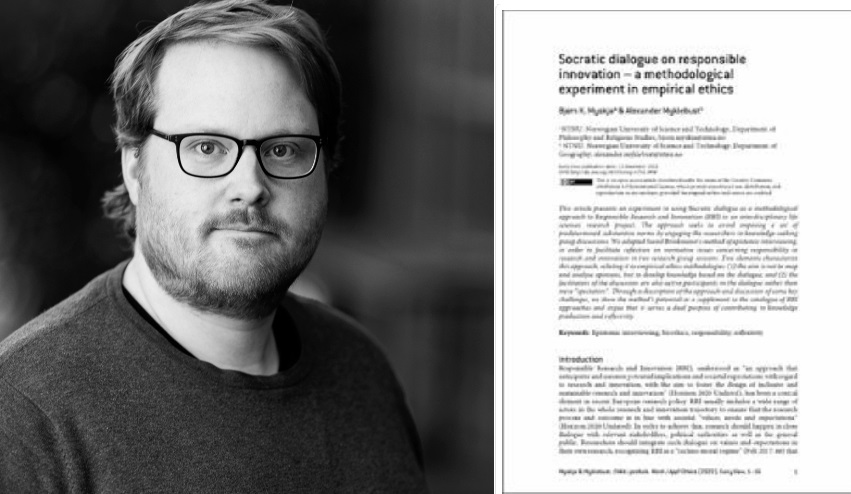
Myskja, Bjørn Kåre & Myklebust, Alexander (2022). Socratic dialogue on responsible innovation – a methodological experiment in empirical ethics. Etikk i praksis. ISSN 1890-3991. 17(1), p. 29–44. doi: 10.5324/eip.v17i1.4950. Full text in Research Archive
What was your role in OXYMOD?
My role in OXYMOD was to be an RRI facilitator. I did this work while I was a ph.d-candidate at the Department of Philosophy and Religious Studies at NTNU, and I shared the role of RRI facilitator with my main ph.d-supervisor Bjørn Myskja. The work was funded by the RCN BIOTEK2021 programme.
We chose a methodology where we as facilitators were not embedded in the daily work of the scientists working in OXYMOD. Instead we opted to carry out the RRI work in meetings where most of the participants in OXYMOD were present, and where we could facilitate discussions within the group.
What was most interesting in your work with OXYMOD?
It was very interesting to experience the dynamic of the OXYMOD group, both in the RRI discussions, but also the other parts of meetings, which concerned more of the science itself. It was particularly interesting to enter into a group mostly consisting of natural scientists, and experience how they thought about, disagreed and discussed the relationship between science and society. I hope (and dare to believe!) that the Socratic method we employed in the OXYMOD project was somewhat helpful in facilitating an open discussion about things that the individual researchers might have thought about, but which they may not have had the opportunity to discuss with each other in the day to day. I do not think that RRI made the OXYMOD-researchers more reflective per se, but rather that it did afford them the time and opportunity to engage in shared reflexivity.
What were the challenges you experienced in the process and how/did you tackle them?
The biggest challenge during the RRI work was definitely the COVID-19 pandemic. We were planning to follow up our RRI work on several meetings, but this was stopped because of the lockdowns. This had negative consequences for the RRI work in the OXYMOD project, as we were not able to follow up on discussions we had facilitated at earlier meetings. This also meant that when it came time to write an article based on our RRI work we did not have as much material as we initially hoped. The uncertainties around the situation made it difficult to plan ahead and mitigate the disruption.
How is the methodology described in Myskja’s and your article different from other “RRI approaches”? What do you lose and what do you gain from using this approach of Socratic dialogue?
We wanted in a way to find a specifically “philosophical” approach to doing RRI. We embarked on a methodological experiment utilizing a Socratic method, heavily indebted to the work of Svend Brinkmann and Hans Skjervheim. By framing the group discussions in terms of a Socratic/epistemic search for truth, wherein disagreement, argument and justifications of opinions are just as important (if not more!) than the opinions themselves, we hoped we could facilitate an ongoing dialogue where the participants themselves could to a large extent decide on what should be discussed and how. Skjervheim’s distinction between “participant” (deltakar) and “spectator” (tilskodar) was helpful in conceptualizing our role as facilitators. In very short terms, the distinction regards how one engages with the utterances of other people: while the participant engages with the subject matter the other is talking about, the spectator makes the other and their utterances into their own subject matter. While we could not completely avoid being spectators, since we facilitated the debate and planned to write an article based on transcripts from the RRI-discussions, we strove to also be participants, meaning that anyone in the group could question us and our assumptions, while we could also question their claims and assumptions.
What I think we gained by employing this, potentially rather confrontational and unfriendly, method was perhaps ironically, a certain degree of trust and openness in the group discussions. By facilitating a discussion where our own role as facilitators could be problematized and where critical views and questioning within the group was encouraged, I think made it possible for participants in the discussion to talk about what mattered to them. As we discuss in our article, I think our methodological experiment showed promise in allowing participants to engage with values underlying innovation and research.
The virtues of this methodology should not be overstated, however, and one must carefully consider when and how one chooses to do Socratic interviewing of the sort we facilitated in OXYMOD. One drawback of this methodology is that it is not very attentive to power differences. For instance, in a research group, there might be junior members who are not comfortable with speaking up, and disagreeing with their seniors. As we suggest in our article, such power imbalances might be evened out somewhat by for instance also doing work in smaller groups.
Responsible Research and Innovation is an important part of our work in the Centre for Digital Life Norway. (Read more about RRI in DLN). To highlight the people working with RRI in DLN projects, and to make RRI more tangible and understandable, we have a series of articles from the vantage point of the RRI experts working in projects. Read more experiences here:
Whose responsibility is it anyway? An embedded philosopher’s study
RRI in action: lessons from Norwegian biotech projects
RRI can take many forms, and be both “quite interesting and quite confusing”
How did you become interested in RRI?
I must admit that I only became interested in RRI when I found myself in a ph.d-candidate position which required RRI-work. I struggled a bit trying to find a way into RRI which I felt was properly “philosophical”, whatever that means. Being involved in the RRI-work in OXYMOD turned out to be a positive experience, which taught me the value of actually doing the Socratic thing, and engage seriously in epistemic truth seeking, even if that means that I sometimes have to leave my office.