index.html
ProstOmics
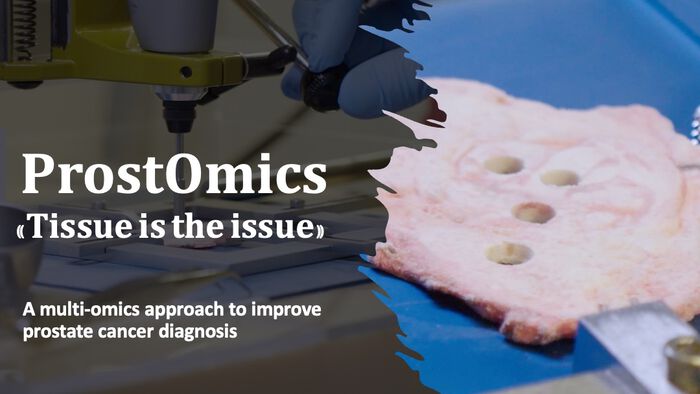
'Tissue is the issue': a multi-omics approach to improve prostate cancer diagnosis
Highlights 2024
During 2024, our research has focused on the spatial multi-omics data analyses which has provided 4 new research papers. To truly understand the cancer biology of heterogeneous prostate cancer (PCa) tumors, capturing the complexities of multiple omics levels and the spatial heterogeneity is our aim.
To accurately combine our complex data material on spatial transcriptomics to spatial metabolomics, we have developed an opensource Multi-Omics Imaging Integration Toolset (MIIT). (https://www.biorxiv.org/content/10.1101/2024.06.11.598306v1). By using MIIT, we have detected important pathways for separating aggressive from slow-growing PCa. We identified endoplasmic reticulum (ER) stress responses where apoptosis was less pronounced in recurrent PCa tissues compared to non-recurrent PCa. We validated the prognostic relevance in larger clinical cohorts and suggested that tumor cells in aggressive PCa utilizes stress-resolving mechanisms to maintain proliferation while evading ER stress-related apoptosis. In a European collaboration, we used a multicenter-cohort on spatial transcriptome data where we discovered club-like cell types as a key subtype acting between the prostate and the immune system (Kiviaho et al, Nature communications 2024). These club-like cell type areas have depleted androgen signaling and indicates androgen deprivation therapy resistance, providing a rationale for therapeutic targeting. In another study, we reported that aggressive PCa is associated with an increased inflammatory status linked to chemokine production and club-like cell in pre-cancerous prostate glands displaying aberrant metabolism. (https://www.biorxiv.org/content/10.1101/2024.05.13.593822v2). A new gene signature specific to a distinct sub-group of non-cancerous glands in relapsing cancer and a novel relapse associated gene expression signature characterizing relapsing patients were identified and validated in larger patient cohorts in this study.
The one highlight of 2024 has been the production of all results from the multilayer spatial omics data. The added value of being a part of a transdisciplinary center is the research community, workshop activities, presentations and the possibility of research cross disciplinarity.
Project overview
Project lead: May-Britt Tessem
Institution: Norwegian University of Science and Technology (NTNU)
Funding: ERC 1.5 million EUR
Duration: 01.02.2021 - 01.06.2023
Publications
Research group
Learn about the ProstOmics in four minutes in this video
About the project
The main goal of the ProstOmics project is to improve diagnosis and prognosis of prostate cancer. The project will investigate relevant biomarkers and molecular pathways to discriminate aggressive from indolentslow-growing cancer. New biomarkers can avoid over-treatment and reduce work-load and economicburden for the health-care system and at the same time improve patient quality of life.
The ProstOmics project is highly transdisciplinary in using various in-front methodology within -omicsdata especially focusing on spatial information and the study of microenvironment andheterogeneity. The project have therefore several national and international collaborators within several of these scientific fields.
The project use integration of omics technology (metabolomics, transcriptomics, genomics, proteomics, metallomics) to study tissue samples and biofluids (urine, blood) from large-scale biobanks of prostate cancer patients. The main research aim is to discover and validate biomarkers and molecular signatures for separating aggressive from indolent prostate cancer.
Latest news from the project
-
ProstOmics awarded another prestigious grant from the European Research Council June 10, 2022 9:53 AM